The Many Uses of an Opal Fire Stone
- Sudhanshu K
- Nov 28, 2022
- 3 min read

Whether you are looking for a stone to adorn your home or office, or to use in a craft project, there are several reasons why an opal fire stone would be ideal for you. It's unique coloring, Mohs hardness, and protection qualities make it an excellent choice for a variety of purposes.
History
Across the globe, Fire Opal has left a lasting impression on many cultures. In addition to adorning jewelry, Fire Opal was used in healing rituals and religious ceremonies. It was also a coveted stone among indigenous peoples in South America. It was also used aggressively by artisanal craftsmen to enhance sculptures.
While fire Opal gemstones has been revered as a good luck stone throughout history, the stone has also been associated with many other negative qualities. Throughout history, it has been rumored that Opal is linked with famine, pestilence, and the fall of monarchs.
In the Roman era, Opals were considered valuable and precious. The Romans believed they could be a sign of good luck. They were also valued for their color and for their powers of prophecy.
Common uses
Whether it is for its spectral beauty, or its healing properties, the common uses of opal fire stone are very diverse. They are used to stimulate visions and communication, enhance psychic gifts, improve health, and help with healing. They are also believed to bring good karma and good fortune.
They are also believed to increase wealth, enhance abundance, and promote relaxation. They are particularly helpful for meditation and prayer. They can also assist in cleansing the physical body.
Fire opals can be found in a number of different locations, including Mexico, Guatemala, Turkey, and Honduras. They are also found in parts of Canada and Ethiopia.
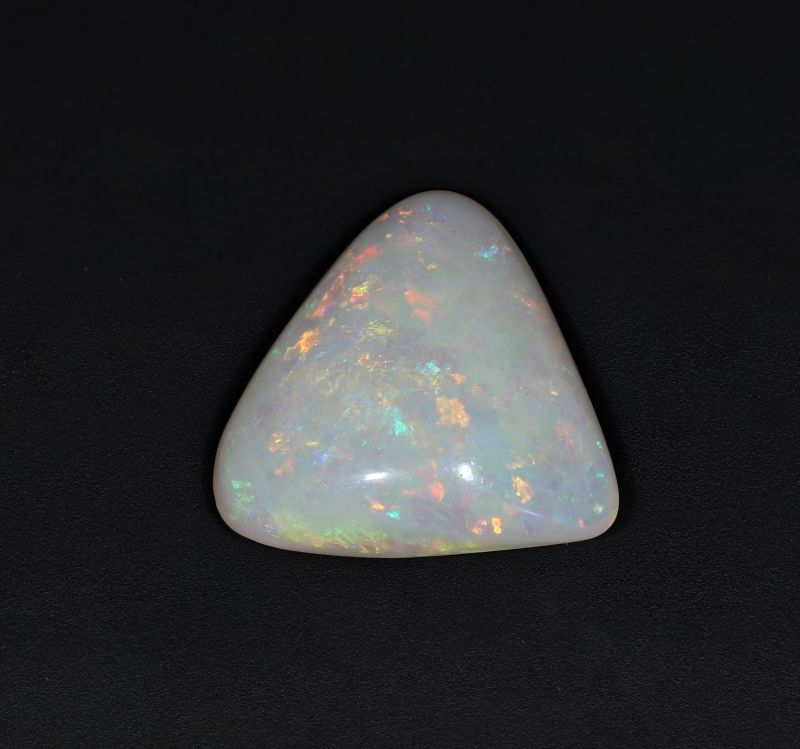
Fire opals can be translucent or opaque. Some specimens are called precious fire opals. These are particularly beautiful because they are transparent with a vivid, play of color.
Protection
Whether you want to create a jewelry piece with a firestone or you want to display it in your office, it is important to protect your stone. Fire opals are fragile, so they need special care.
The first step is to ensure that your stone is safe from heat and water. It is important that you avoid extreme heat and water when wearing your opal firestone. This includes not wearing it while swimming. Also, do not use harsh chemicals when cleaning your stone. Instead, use a mild detergent and warm water. This will help prevent your stone from crazing.
When opal is exposed to water, it becomes milky. This milky Opal will eventually become transparent. However, the stone will be damaged if it is exposed to water for a long period of time.
Mohs hardness
Using the Mohs hardness scale, the hardness of a mineral is measured. The scale ranges from one to ten and the higher the number, the harder the mineral. The hardness of a mineral is the degree to which it can resist damage from scratching. This scale is a helpful tool for field geologists to measure the hardness of minerals.
The Mohs hardness scale was first developed by German geologist Friedrich Mohs in 1812. It measures the relative hardness of a mineral by scratching it. The scale is not very precise, and there are no guarantees of absolute hardness. However, it does provide an overall measure of strength.
There are different gemstones that fall into each of the intervals on the scale. The harder gemstones are rated closer to 10 on the scale. The softer ones are closer to one.
Play-of-color
'Play-of-color' is the term used to describe the optical phenomenon that occurs in precious opals. Light interacts with the silica molecules within the opal, causing changes in color. The play-of-color is caused by light hitting the silica molecules at different levels, resulting in patterns. This is a natural phenomenon.
Play-of-color occurs in a variety of opals. Some opals will have a strong play-of-color, while others will have a weaker play-of-color. The amount of play-of-color in opal is also a factor that affects its value. Typically, opals with bright, saturated colors command higher prices than opals with less saturated colors.
Play-of-color is also affected by the angle of the light. Light entering the opal will pass through gaps in the silica molecules. Light passing through smaller gaps will produce greens and blues, while light passing through larger gaps will produce yellows and reds.
Buy certified gemstones online at an affordable cost at ratanrashi, shop available at c/o Sudhanshu JI Ratan evam Rudraksha 15-16 Hari Laxmi Lok building, Eves Crossing, Meerut City, Uttar Pradesh - 250001, INDIA


Comments